Thursday, January 8, 2015

Layla Among the Stars

Layla is a pit-bull/dalmatian mix who was adopted by a friend of mine. She's an incredibly sweet dog and I wanted to make a keepsake for my friend for the holiday. Being a classic rock fan, he named her after the Derek and the Dominoes tune. The reference wasn't lost on me, but as an amateur bellydancer and fan of Arabic music, my own mind went to songs like "Laylet Hob" ("Love Night") and "Auf Layla Wa Layla" ("A Thousand and One Nights"). That's where the stellar theme originated and why I decided upon using the Middle Eastern-inspired frame.

This is the reference photo which I used for the portrait. It was taken with my cell phone so it's not spectacular in quality, but it sufficed. I decided to change the angle of her neck to suit the composition.

Here she is carved and her name pyrographed into the lower banner:


The leather stains were applied to lay in some base shading and coloration:


Acrylic paints were layered over the stain to add highlights and more prominent color (although you cannot see in the photo, some metallic gold was added for the stars and to accent her name):


An acrylic resolene finish was added to provide some protection and seal the piece. It ended up a little more glossy than I had anticipated. The higher gloss finish really upped the contrast and allows some of the more delicate sculpted details to catch the light:


This is the completed ornament with the leather cameo layered over felt and embellished with bead and thread embroidery. Three little sequin stars are sewn near the top to continue the stellar theme:


I really enjoyed creating this ornament, and I'm considering offering the occasional custom pet portrait in the future via my Etsy shop. Would anyone be interested if I presented the option for pet portraits similar to this piece and the one I previously did of the thoroughbred Tully? I would probably set it up where an initial deposit would be due to get the project started and then the remainder would be due upon completion.

Monday, January 28, 2013

A New Version


I had a few people ask me about when I might be making a new Lost & Found necklace. The design itself was in desperate need of refinement and I've finally gotten around to working on the redesign. The new sketch (on the top) is a bit more naturalistic and a lot less wonky, in my opinion.

A Winter Blessing

The All-Seeing Eye brooch has been completed and is now available in the shop. I'm really pleased with the layered look and all the media I got to incorporate into it. This was the first time I used the blanket stitch on a larger scale, really putting the final seal on it and making it a pleasant little packet that feels good resting in the hand, which I think is a good trait in an amulet.

I also added a new necklace to the shop with a more seasonal vibe: Winter Blessing Necklace. I subtitled it on Etsy as both "rustic" and "runic" because the birch bark texture, hand-stitched detail, and warm red felt lend it a bit of a Scandinavian cabin aesthetic and a bindrune forms the main graphic element. I designed and crafted three of these pieces for the Winter Solstice/Yule and gave two of them as gifts to dear friends, but I decided to offer up the last one for sale. Although all of my work is infused with care and intention and I enjoy working with symbols and esoteric themes, this is the first specifically charged, magical creation I've offered in my shop (it will likely not be the last though). It's not as technically complex as some other pieces I've made, but it has that extra charm that comes with a piece of this nature. You can read more about the purpose and elements of this talisman in the Etsy description.


Wednesday, December 26, 2012

Horsing Around

I've been plugging away at some projects for the shop but have been remiss in sharing them. This one in particular is not for sale as it was created as a gift for someone in particular, but I wanted to share it anyway because I took photos throughout the entire process. Since it was a Christmas present and I found myself a little bit rushed for time, I didn't have the opportunity to have a proper photo shoot so unfortunately these iPhone photos will have to do.

I've toyed with the idea of doing custom pet portraits in leather and I decided to try it out. I asked my fiancee if he could take a picture of his mom's favorite horse the next time he visited his parents' house, and he brought me back a nice, though slightly blurry, photo of Tully the thoroughbred.

Normally I start by making a sketch which is then turned into a pattern. The pattern is what I use to inscribe the basic design onto the leather itself. This time I used the photo reference from my iPhone and sketched with an awl lightly onto the leather. After cutting the major lines with a swivel knife and some tooling, I was really happy with the dimensionality I was beginning to see.

I didn't want to complicate the background too much as it is a small piece and I didn't want to distract from the portrait, but it definitely needed something. I decided to pyrograph some Celtic knotwork to add some interest. I also used a matting stamp around the horse's head to help visually separate it from the smooth background. I later found out that Tully was born and bred in Ireland, and my fiancee's mother had actually met the breeder there when they visited many years ago.
   

Then it was on to painting! The photo was a bit overexposed so it was even harder to get a true-to-life color match, but I know that Tully is a bay with a white star.
This photo really clarifies the scale of the leather cameo (I forgot to take actual measurements but I'm estimating that it was about 1.5" wide by about 2.5" tall).

It was originally intended to function primarily as a brooch, and it does in fact have a pin back attached, but after I was laying out the felt and other fiber notions I wanted to use, I realized it would make a good ornament, so I added an eyelet to the top so it can be threaded with some ribbon and hung.
Here's what it looks like as an ornament:

My future mother-in-law really liked it, and I freely admit it made my inner, 12-year-old, equine-obsessed self very happy to make it.

A (slightly belated) Happy Holidays to you and yours!

Sunday, September 2, 2012

The All Seeing Eye . . .

watches me make things :)

Here is an in progress photo of another brooch in what I'm planning to be an occult/esoteric imagery themed series. The mystic ocular symbol which forms the basis for the design has intrigued me for a while, and I've found that eyes are really fun to tool in leather (I've already started a second version of the central leather cameo). I've layered the carved leather over some tea-stained lace. It's accented with various sized eyelets, some of them set with glass pearls, and three spots. I still need to do some more hand-stitching, attach the pin back, and secure the backing layers together.

The symbol can be traced back to the ancient Egyptian udjat, also known as the Eye of Ra or the Eye of Horus, which had solar associations. It was a favorite apotropaic amulet in that culture. Many later depictions feature the eye surrounded by a halo of rays of light. It was then adopted as a symbol of the all seeing eye of the monotheistic God and came to be known as the Eye of Providence. At some point, it was overlaid on a triangle, which could suggest a link back to its Egyptian origins, but according to some sources the triangle was said to represent the Christian trinity and thus was widely used in a Christian context over the past few centuries to represent their God's omniscient nature. This is rather ironic considering that if you do a search on "all seeing eye" it brings up many links from conspiracy theorists who claim the symbol, which appears on the Great Seal of the United States, is a Satanic/Pagan/Masonic/Illuminati/Insert-Your-Boogeymen-of-Choice icon and indicates their subversive nature.

Monday, August 27, 2012

New in the Etsy shop

We've been having some strange weather today. Just moments ago it was torrential downpour, now it's bright and sunny.

As promised, I've finally added some new items to the shop. One of which is the aforementioned Verdant Skull brooch which turned out very nicely. It's actually available in time for my favorite holiday season: Samhain, Halloween, El Dia de los Muertos, Winter Nights, etc.

The other piece I'd been keeping to myself for a long while. One of the towns which I pass through en route to work holds a yearly carnival. From the road, I can see the tops of the striped tents and that is what inspired this design. It took a while for the whole necklace to come together as this was really the first leather/fiber/metal/bead experiment I've done, but I'm pleased with the results. Since the carnival is in town again, it felt appropriate to post it.

There are additional photos of each piece on Etsy :)

If you've been to the Phée Adornments Etsy shop recently, you may have noticed that something is missing. I'm trying to grow towards a certain aesthetic for my jewelry and leather craft which doesn't exactly mesh with the artwork I am offering at the moment (I'm also a little OCD and like things to be organized into sensible categories!), so I decided to make a separate shop for my art prints and originals. You can now find my available work at www.DesireeIsphording.etsy.com. In addition, I moved the bellydance-specific art (namely ACEOs) to my bellydance shop: www.CarrouselBellydance.etsy.com.

Monday, August 13, 2012

Verdant Skull Brooch in progress

I know, I know... I've been a very bad blogger. I apologize and hope to do better in the coming months. At the very least I'm hoping to provide more in progress photos and visual insights into my design process, so there will be some more images to enjoy. I recently joined the current decade by purchasing an iPhone (the photos it takes are much better than the ones my iPod Touch generated) so that means it will be easier to document new creations before taking the more official, polished photographs for the Etsy listings.

Case in point is a design of a Verdant Skull cameo for a new series of brooches influenced by esoteric and occult imagery.Since the brooches will be relatively small (at a certain point large brooches become too awkward to be functional brooches, in my opinion), it also gives me the opportunity to use up some scrap leather from other projects. I try to always be cognizant that leather was once part of a living being and I don't want to be wasteful. I did some preliminary sketches which were not to scale in a notebook before drafting the design, but the photo below shows the progress from a pencil sketch at the appropriate size, the pattern which I use to transfer the design to leather, and the actual design realized in leather. I recently acquired a new friend for the studio, a Razortip SK pyrography tool, and this is the first time I've combined pyrography with the leather carving I typically do. Now that I have an idea as to what it can do, the possibilities are making me a bit delirious (in a good way)!
What I'm really loving about this brooch series is the prospect of combining leather with various other media. I have some weird fondness for sewing things by hand that I'll get to indulge since I'm going to be layering the leather cameos with felt, lace, trims, etc. Some bead embroidery may also be in the forecast for these. Below you can see the progress made on assembling the actual brooch. I've layered the leather over some vintage lace which I tea-stained, striped trim, and a velvety millinery leaf. I sewed a lovely patina-ed brass key charm below the cameo and added an eyelet so I could dangle a turquoise nugget from the bottom.
I want these brooches to resemble some antique, intricate medals I have seen and I'm really pleased with how this particular one turned out. What the above photo doesn't show is that I've tried to lend a more aged look to the fabric by staining the edges with a sepia-toned ink. I attempted to take some better photos today, so hopefully it won't be long until this piece is listed on Etsy.

Although my time is still divided between a full-time job, an internship, and my various other hobbies and interests, things are slowly falling into place for me and that means I have more motivation and energy to make things.

Truth be told, I've also been holding out a bit on listing some new items until I figured out a new logo and identity for this endeavor. My work has changed so much since I first starting making jewelry several years ago, and I've outgrown my old branding. There were some items I did not want to present until I had something new to replace it. I think I've finally hammered out a design I'm pleased with although I still need to do some additional work before finalizing a new business card, etc. but I feel more comfortable posting those items.

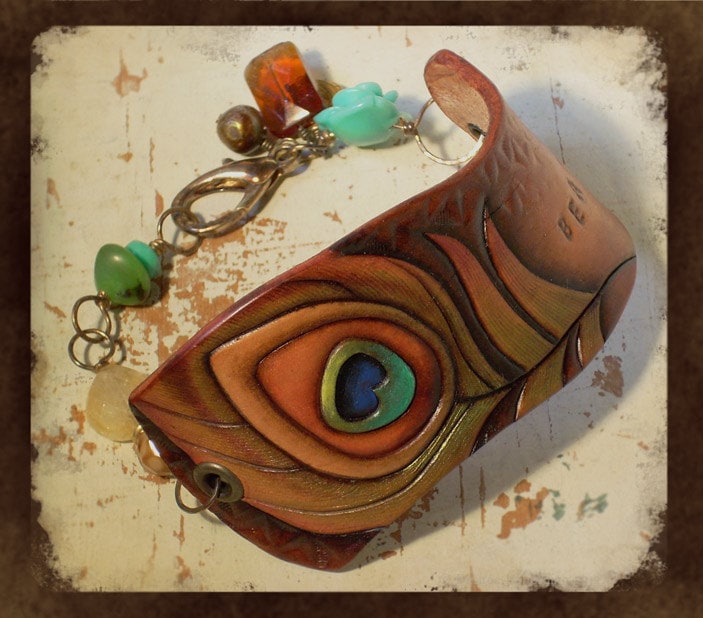
I wanted to share the second version of my Peacock Feather cuff bracelet as an opportunity to discuss reserved listings. I had just carved and tooled the leather portion of this cuff when someone contacted me to ask about the previous version I had made. The timing worked out perfectly. I finished the cuff and listed it on reserve for her, and hopefully she's wearing it right now :)
While I'm not taking custom orders at this time, if there is an in progress piece shown here that hasn't yet been posted on Etsy which catches your eye, I'm willing to temporarily reserve it for you once it is listed for sale. Please contact me via email or Etsy conversation to discuss this option. Reserves of this kind are on a first come, first serve basis and if you do not purchase the item within the specified time period, I will remove the reserve so potentially anyone can purchase it.

Monday, March 21, 2011

A Beaded Gift

I made this brooch as a present for my grandmother's 75th birthday. It's a bit belated but I hope she will appreciate it anyways. I really like the neutral, faded palette of creams and ivories and hope to work with it more. It features vintage (possibly antique) bone buttons acting as cabochons, a resin flower, a brass filigree bead along with several freshwater pearls, glass pearls, crystals, and seed beads.

I have lots of other goodies including milagros, vintage watch parts, Turkoman buttons and other tribal accoutrements that I want to incorporate into similar pieces in the future. My grandmother is a bit on the more traditional side though so I didn't think she would appreciate a more steampunk edge to her particular brooch. I couldn't resist adding a slight grungy touch to this pin though with two primitive-looking, irregular circular beads that look like they may have once been part of a well-loved necklace. I actually have another brooch/hair clip in progress that I hope to have completed soon which has more of an eclectic influence.

Beading is very therapeutic, and taking into consideration my stress levels as of late there may be a lot of beaded items making their way into the shop.

Monday, January 10, 2011

A Songbird Taking Wing

I've been slowly easing myself back into making things after a considerable lull. Several months ago I carved this little songbird pendant and I just started to stain it yesterday evening. I thought you might like to see how it has progressed so far. The photos were taken with my iPod touch in artificial light, so the quality isn't the greatest.

I generally tend to layer my leather dyes, working from light to dark, building up the colors for a richer tone. In the image below, the lightest stain I currently have, Canyon Tan, has been applied to sketch in the bird's markings.

In the second image, I've added black to define the eye and I've layered two darker browns over parts of the initial stain to bring out some of the patterns in the plumage.
I'm tempted to leave it like this as the tone-on-tone dyes over the natural color of the leather is really appealing, but as with the previous songbirds (Sparrow & Finch) I'll be adding some acrylic to add more dimension and color. This little birdie is another sparrow, and her markings are a melding of those of the Chipping and Song Sparrow species.

Monday, December 27, 2010

A belated happy holidays to you and yours!

I wanted to take a moment to thank Molly, who is a fellow Pennsyltuckian and crafty gal, for featuring my work in her blog Molly's Muses. She had included my Pennsylvania Wildlife bracelet in a post back in November, and her thoughtful husband purchased it for her as a Christmas gift. She's now featuring it in her post-holiday entry. I definitely have to agree with her sentiment about handmade gifts. I gave my mom an adorable Boston Terrier necklace from LuluBug Jewelry, and some of my favorite presents include the awesome Muertos the Sugar Skull plush, a Namaste rim-blown flute made by Anasazi Dream Flutes, and a pair of Mayan-style flared plugs from One Tribe.

I've also neglected to mention some Treasuries in which my work has been featured. The first one is appropriately holiday themed, evoking visions of candy canes and sugar plums. I love the combination of turquoise and red in this collection!

The second two feature my Circus Caravan cuff.
I love the Bohemian vibe of this treasury.

I've been in the doldrums as far as my artistic endeavors are concerned, and I'm hoping that the new year will bring with it a renewed creative spark and thus some new items in the Etsy shop.

Sunday, November 28, 2010

The Art, Craft, and Design of the American Carousel Menagerie - Part II

If a modern amusement park seeks to find an antique carousel to put in a place of honor on their grounds, they will often find themselves out of luck since such carousels are so scarce. Amusement parks will often resort to importing “mostly from Italy, new mass-produced carousel with elaborate decorations but with characterless fiberglass animals” (Hinds 123). While there are still American companies that make merry-go-rounds, their figures are all fiberglass as well. However, the tradition of American hand-carved carousel animals is not entirely lost. With the renewed enthusiasm for the antique carousel has also developed a renewed desire to perpetuate its tradition. For example, Le Carrousel de Lancelot in Europe’s Disneyland near Paris, France features an outer row of sixteen hand-carved horses designed and carved by American Joe Leonard (National Carousel...). Other projects involving contemporary hand-carved animals are also in place, including a 48-figure carousel of endangered species (Fraley 108).

The progression of techniques and technology used in the creation of the carousel animal mirrors similar progressions in other crafts and eventually develops into a more design-oriented production. Carousel carvers worked in a traditional crafts medium: wood, and, in fact, many of those carvers had previous experience in the crafts. Before immigrating to the United States and trying their hand at carousel figures, many carvers worked as furniture-makers, cabinet-makers, carvers of religious iconography. Only a select few of the notable carousel carvers had any formal fine art education, one of whom was D.C. Muller who studied at the Pennsylvania Academy of Fine Art. Carousel luminaries including Charles I.D. Looff and Gustav Dentzel started off as individual craftsmen, producing their own carvings to adorn their machines. Since they operated the machines themselves, their creativity was not bound by the preferences of a specific client. After their increased success with their self-constructed machines, they acquired other carvers to help them in a manner similar to other crafts studios. Much like the studios and workshops of the Arts & Crafts movement, the carousel workshop was based on the medieval model of apprenticeship wherein those still learning the trade would literally work their way from the basic to more complex, artistic tasks. The carving of the horse’s or other animal’s heads was always the duty of the master carvers, while the other portions of the body were usually carved by the less experienced. Although each company often had a set of general patterns they chose to work from, individual carvers were generally given the freedom to express themselves via the animal’s trappings.


Horses from the Grand Carousel at Knoebles Amusement Resort in Elysburg, PA. This is a Kremers Carousel Works machine featuring horses carved by Carmel. It is one of the few remaining carousels with an operating brass ring mechanism. Additional photos can be found here.

A device known as the carving (or duplicating) machine has been in existence since around 1900. It consists of a series of connected routing bits which replicate a three dimensional object in wood using much the same principles as a key-making machine. A finished product is placed in a central position, while four un-carved pieces are stacked above and below it, fastened in place while the bits progressively carve away at the nondescript blocks using the finished piece as a guide. While this machine was in limited use for many years as a means to rough out figures before human carvers would refine and elaborate the finished product, it later became a means to produce the ultimate figure. The design of the carousel figure truly became separated from the actual craft of carving them when “owners of many companies then realized that they could lower their costs and become more competitive by simplifying their designs so that they were more compatible with the carving machines” (Fraley 87). In further pursuit of lower expenses and greater production, the Allan Herschell company began producing first legs, then heads, and then entire horses of cast aluminum in the 1920s. The animals produced by the carving machine and in cast aluminum were designed with the medium and limitations of their production in mind. The results were more compact, stocky horses with trappings of flattened, geometric planes. The manes of the horses were securely plastered to their necks, their ears flattened back so as to not protrude.

While the carvers of carousel animals were technically producing functional objects for a commercial purpose, their efforts go far beyond mere factory work and enter the realm of fine crafts and even art. As Fraley points out, “the drive to create, for these few select craftsmen, must have gone well past the bounds of just making money. There is no doubt that the sculpting of wooden figures represented an expression of the maker as an artist. The exacting detail, the sweeping flamboyance, and the sensuous grace and beauty of many of the figures created by these men reveal an ambition beyond the creation of a seat on an amusement park ride” (70). Despite the overwhelming demand for his work, Coney Island Style carver Marcus Illions chose to rein in the volume of production as so not to sacrifice quality and artistic expression. It was said that he personally carved all of the heads of the figures that came from his shop, and he often carved the entire bodies of outside-row figures, which was quite an uncommon practice.

The horses and other animals created to whirl on the carousel platform exhibit skill, creativity, intention, and consideration for the aesthetic principles of composition, color, form, line, etc.; otherwise stated, they possess the same defining factors as other words of art. Now that operational, hand-carved wooden carousels are becoming a rarity, even the contemporary art establishment has begun welcoming these creatures into its fold. Frederick Fried, author of the seminal book A Pictorial History of the Carousel, helped to bring the significance of the carousel as art to light:
The carousel as a work of art was first brought to the attention of the American Public in 1964. It was then pointed out that the working carousel contained all the elements of the arts - sculpture, painting, music, and motion. The first museum exhibition of the carousel was at the Museum of Early American Folk Art in New York in 1970 under the title “Art of the Carousel.” I was the curator for that exhibition. The American public since has become aware of the beauty of the carousel and has cherished it as a complete work of art. (Hinds x)

This photo is of the second antique merry-go-round, the Kiddieland Carousel, located at at Knoebles Amusement Resort. It is a smaller scale carousel created by Stein & Goldstein and most of the steeds have actual horsehair tails. You can take a virtual tour of this carousel here.

Major art museums, including the Philadelphia Museum of Art which counts two carousel animals in its collection, are acquiring them for display and appreciation, and across the country numerous museums specifically dedicated to the art and history of the American carousel exist. The carousel figure’s new found status as art object is evident in the prices such figures command both at auction and through dealers. According to the records kept by one major producer of carousels, the Philadelphia Toboggan Company, the “price for carving 46 animals for one carousel in 1914 cost PTC $1,716” (Manns 92). Today, a restored 1915 horse carved by Marcus Illions which once occupied a four-abreast machine at the Willow Grove Park in Willow Grove, Pennsylvania has a price tag of $17,850 (Hand Carved...). The artistic and monetary value of these hand-crafted animals is also vouched for in an unusual manner by the fact that Mexican artisans are now producing copies of American carousel figures in order to sell them to uninformed individuals under the pretense of authenticity (Hinds 104). Nina Fraley writes of the resurgence of interest in antique carousels and of the issues its recognition as art brought up: “Organizations sprang up filled with enthusiasm for history and restoration techniques. Books were published and study grants were awarded. Museums exhibited carousel art as a legitimate segment of our national heritage, and arguments ensued over ‘Folk Art’ and ‘Fine Art’ labels” (Fraley 14). Carousel enthusiasts contest to some descriptions of carousel art as demeaning, inaccurate misnomers:
The term ‘primitive’ is generally used to designate unschooled, crude, naive, or unsophisticated art. Most of our carousel carvers were unschooled in sculpture, naive and unsophisticated in their art understanding. But it can hardly be said that theirs was a ‘primitive art,’ nor because of its large commercial use, can their art be termed ‘folk art.’ Actually, theirs was a straightforward statement with a primary concern for the elemental. Nor were there any signs of crudeness in the products of the carousel manufacturers after the 1900 period. (Fried 118)

Undoubtedly, the debate as to what sort of art the carousel figure represents will continue, but it is still a great step in the effort of carousel preservation and appreciation for it to be rightfully acknowledged as art.


Bibliography
Fraley, Tobin. The Great American Carousel: A Century of Master Craftsmanship. San Francisco: Chronicle Books, 1994. ISBN 0-8118-0610-3.

Fried, Frederick. A Pictorial History of the Carousel. Vestal, NY: The Vestal Press Ltd., 1964. ISBN 0-911572-29-5.

Hand Carved Carousel Horses (& More) on Consignment.
http://www.finest1.com/hand/betty.html

Hinds, Anne Dion. Grab the Brass Ring: The American Carousel. New York: Crown Publishers, 1990. ISBN 0-517-57486-1.

The International Museum of Carousel Art. http://www.carouselmuseum.com/

Manns, William and Marianne Stevens. Carousel Art. Volume 1. Millwood, NY: Zon International Publishing Co., 1986. ISBN 0-939549-03-04.

Manns, William, Peggy Shank, and Marianne Stevens. Painted Ponies: American Carousel Art. Millwood, NY: Zon International Publishing Co., 1986. ISBN 0-939549-01-8.

National Carousel Association - Le Carrousel de Lancelot. http://www.nca-usa.org/psp/DisneyParis/

Weedon, Geoff and Richard Ward. Fairground Art. London: New Cavendish Books, 2005. ISBN 1-872727-74-3.

Monday, November 22, 2010

The Art, Craft, and Design of the American Carousel Menagerie - Part I


My grandfather & I riding the Prince Charming Regal Carrousel (formerly called Cinderella's Golden Carrousel) in Walt Disney World which was the Philadelphia Toboggan Company's 46th machine. Photo circa 1989.

I've been enchanted by carousels since I was very young. My family and I used to attend annual holiday parties at my great aunt's house and I always looked forward to visiting her home so I could engross myself in her copy of Painted Ponies. My parents eventually purchased the book for me as a Christmas present which really set my obsession into motion. I would bring along my camera to every amusement park we went to in order to document the merry-go-rounds therein, and carousel animals populated my artwork for several years (there is a precedent for all of my recent carnival-themed jewelry!). I attended the ceremonies at the Carousel World Museum in Lahaska, PA (unfortunately now defunct) when the US Postal Service premiered its series of four carousel-themed stamps in 1995. The subject of my first research paper, assigned during the last year of elementary school supposedly to prepare us for the rigors of middle school ahead, was carousel art. This also coincided with the time period where the local Alan Herschell Company machine, the Perkasie Carousel, was undergoing restoration. I wanted so badly to assist in the re-painting of the aluminum horses and volunteered for it, but unfortunately I was not asked to participate. I did get to help with raising some funds for it at my school though which was some consolation. My obsession faded a year or so after that, but I still greatly appreciate antique, hand-carved carousels for the supreme examples of art and craft that they are. Towards the end of the Spring 2006 semester of my college studies I was struggling to determine a final essay topic for a class on the history of American craft. It dawned on me that my youthful obsession could prove of great use and the essay below was born. I hope that you enjoy it and the photos accompanying it.


Throughout the history of their creation, the lively figures of the American carousel have been embodiments of art, craft, and design. Even though during their production and in the heyday of their use they may have been largely viewed as whimsical elements contributing to the overall amusement experience provided by the carousel, it would be difficult to deny that carousel animals are indeed works of craftsmanship, artistry, and considered design. Although such delightful diversions as carousels are often ignored by art and craft historians, they can reveal as much about the overall culture and history of their respective time periods as the fine arts, crafts, architecture, etc. created during the same periods.

The carousel has its ultimate roots in feats of horsemanship and displays of martial skill. In fact, the modern word carousel “derives from the ancient Italian and Spanish words garasello and carosella meaning ‘little war’” (Fried 18). While in Arabia and Turkey, European crusaders observed a game where men on horseback were engaged in throwing and catching small clay balls filled with perfumed water. If one of the contestants happened to miss his catch, he would be saturated with the liquid and clearly marked as defeated. Once this concept was brought back to Europe, it evolved into elaborate tournaments staged by the French monarchy with each horse and rider decadently costumed for the occasion. The Place du Carousel in Paris still bears the name of the extravagant pageant held there by Louis XIV in 1662. Eventually, clay balls were replaced with metal rings and lances. The object became not to simply catch a ball while riding, but to manage a long lance and hopefully to spear a ring suspended from a tree or two posts while riding. According to Fried, “in France about 1680, the carousel became mechanical. Someone thought of suspending horses and chariots by chains from arms radiating from a center pole” (19). Powered by man, horse, or mule, this device was intended as a training tool for those who sought to hone their lancing skills. While the structure turned, an individual on their dangling horse would attempt to spear a stationary ring positioned near the periphery of the spinning contraption. This strange device ended up becoming popular not only as a means to improve one’s lancing aptitude, but for entertainment purposes as well. In the 1830’s a new method appeared which replaced the former technique in which a person or horse manually turned the center pole. This new method utilized gears so that the pole could be turned by a crank. However, the mayor revolution in carousel propulsion occurred when an Englishman named Frederick Savage decided to enlist the steam engine to turn an all-bicycle carousel in 1866 (Fraley 22). Savage is also responsible for developing a system of overhead gears which produce the classic up-and-down galloping motion used on carousels until the present day.

The carousel flourished throughout Europe, and it was only a matter of time before it spread across the Atlantic. The exact date of the appearance of the first carousel in America in unknown. While it has been typically thought that the first American-made carousel was crafted in 1878, there is evidence of carousels in the United States as early as 1825 (Fried 51). According to Anne Dion Hinds though, this date could be pushed even further back in time. She states that “primitive carousels must have been around earlier than 1784: that year New York City Common Council passed a law banning them as dangerous” (40). However, even though stream-driven roundabouts had been enamoring Europe since the 1830s, it would take another fifteen years before steam engines powered their American counterparts.

This is an outside row stander from the carousel formerly operating at Carousel World Museum in Lahaska, PA. This carousel featured a mix of animals carved by different makers. I believe this horse in particular was carved by Charles Carmel. The museum closed several years ago and a different carousel featuring hand-carved replicas of classic animals now operates in this location which is now known as Giggleberry Fair.

When Gustav A. Dentzel built his first American carousel in 1867, it was a simple construction: a series of wooden benches hung by chains from radial sweeps. It wasn’t powered by steam, or even by a horse, but by Dentzel himself. Gustav arrived in Philadelphia, Pennsylvania from Germany in 1860 and set up shop as a cabinet-maker, but carousels were in his blood; his father Michael Dentzel had built and operated several of them back in Germany. A decade later, not only did Dentzel establish his own carousel-building company in Philadelphia, but others were established by Charles Looff and Charles Dare in New York City, and by James Armitage and Allan Herschell in North Tonawanda, New York. The efforts of these early American carousel builders among others produced some of the noteworthy, longest-lived companies.

Three basic styles began to emerge during this time period: The Coney Island Style, the Country Fair Style, and the Philadelphia Style. The Philadelphia Style, exemplified by such companies as D.C. Muller and Bro., the Philadelphia Toboggan Company, and of course Dentzel’s own, is characterized by its “dignified realism” (Hinds 10). The Coney Island Style, named after the famous New York amusement hub which once hosted more than 20 simultaneously operating carousels in its heyday, is characterized by its more fanciful, flashy expressions and ornamentations. Coney Island style animals are often bedecked with gold-leaf manes, their trappings set with small mirrors and glass jewels. Companies and carvers associated with this particular style include M.C. Illions, Charles Looff, Charles Carmel, and Stein and Goldstein. By contrast with the Coney Island and Philadelphia styles and their preoccupation with highly detailed, sophisticated figures, the Country Fair Style is much more simple and less finely-rendered, and for good reason. While most companies producing Philadelphia and Coney Island style carousels were primarily creating so-called stationary or park machines, Country Fair Style companies including those of Herschell/Spillman, Charles Dare, and Charles Parker typically produced portable machines. Excessive ornamentation and delicate features are easily damaged and worn by frequent disassembly, travel, and reassembly. Therefore, many Country Fair style animals have basic trappings and decorations as well as a more rustic charm.

Depending upon who one asks, the “Golden Age of the Carousel” in the United States can be said to span a period from approximately 1880 to 1930 (Hinds 3). The statistics regarding the number of carousels produced during that time period also tends to vary based upon sources, and due to the lack of records, the exact numbers may never be known. For instance, one source states that “of more than 4,000 hand-carved wooden carousels built between 1900 and 1925, fewer than 170 survive”(Carousel Art). Although the statistics may vary, they all reveal the same basic truth: there has been a staggering loss in the number of the nation’s operating antique carousels. Traditional, wooden carousels, once a common sight throughout America in locales both rural and urban, are now an endangered species. The story of the rise, fall, and rebirth of the carousel in the US is deeply tied to the historical, cultural, and technological changes that affected its populous.

A close-up of one of the outside row jumpers from the aforementioned PTC machine at Walt Disney World. I believe this particular horse, along with many of the other more ornate horses on this carousel, was carved by John Zalar.

The real blossoming of the carousel’s golden age can be attributed to transitions brought about by the widespread application of new technology. The industrial revolution was gaining speed, bringing with it time-saving labor devices, electricity, and faster methods of transportation. These elements combined to initiate a phenomenon people today often take for granted — the weekend. Trolley companies, seeking to boost their profits on those days of less traffic, decided to devise an impetus for people to ride the trolleys in their newfound leisure time. That clever invention came to be known as the trolley park, a generally suburban or rural station at the end of the trolley line which acted as a destination of rest, relaxation, and amusement. The centerpieces of these newfangled parks were often carousels. The trolley park turned out to be a success, and as new parks were built, there was more demand for carousels to occupy them. With the growing popularity of carousels, competition between companies increased. Each company sought to outdo one another with the beauty of their carousels, and during this time period trappings became quite ornate. Another result of the carousel boom was that individual carvers decided to break away from their respective companies and forge ahead on their own.

Unfortunately, the golden age was not to last. More novel advances, such as movie theaters, radio, and the automobile began to lead people elsewhere, away from trolley parks and small amusement venues. World War I had a devastating effect, bringing the carousel industry to a standstill, and while business improved somewhat in the 1920s, the carousel would never again reach its former zenith. The carousel was once viewed as an exciting thrill ride, but by this time there were other rides and pastimes that usurped that position, the carousel was now perceived as a romantic vision of a bygone era. The people who were interested in purchasing new merry-go-rounds during this period in history were no longer interested in having a dazzling jewel of a carousel, instead they sought less expensive, basic machines whose ultimate purpose was to turn a profit. While some carousels were still hand-carved, the new desire for cost-effectiveness began to phase out individual carvers in favor of wholly machine-made figures. It would seem that the final blow that caused the demise of the golden age of the carousel was the great Depression, which forced many of the major companies to go out of business. 1930 marks the year of the creation of the last fully wooden carousel (Hinds 47). After the second World War, carousels became regarded as too decadent for the stringent budgets of the time, and were essentially abandoned. Scores of parks were compelled to close their doors forever: “the number of amusement parks has shrunk from a peak of about 1,500 in the 1920s to fewer than 200 major parks, including about two dozen large theme parks, in the 1980s. Fewer than sixty amusement parks and theme parks can offer rides on authentic wooden carousels” (Hinds 47). Many carousels remaining from the golden age were destroyed by flood or fire, and many fell into disrepair. Others were placed in storage, subsequently forgotten, and left to rot.

Decades passed, and Americans, constantly bombarded by new forms of technology and entertainment, started to reflect upon their past:
[F]orty years after the last Philadelphia Toboggan Company carousel was placed, a strange and wonderful thing started happening. [. . .] [People] began to rediscover a sense of cultural heritage, craftsmanship, and design and combined that discovery with a general nostalgia for the “good old days.” [. . .] [C]arousel animals were being dug out of barns and attics and seen anew. People would scratch their heads with amazement when they realized that many of those items were “handmade,” a concept that had been lost somewhere along the line. They started looking around for the people who had created these unique parts of our historical heritage and were deeply dismayed to find that almost all of them were gone. (Fraley 88)
The renaissance of the American carousel was underway.

{Continued in Part II}

Saturday, October 30, 2010

Of ferris wheels and acrobats

I'm in good company when it comes to having a case of carnival-on-the-brain (which sounds like a medical condition brought about by staring too long at spinning lights on the Tilt-a-Whirl combined with an excessive consumption of cotton candy). My Circus Caravan Cuff was included in two fairground-themed treasuries. In keeping with my last post, there are also a fair amount of stripes to be found too!

In the spirit of the theme, I wanted to highlight the work of Carrie Boucher of Pink Crow Studio who makes wonderful use with the fairground baroque aesthetic in her jewelry. The little star cylinders within the pendants actually move with the wearer.

Monday, October 25, 2010

Stripes, Stripes, & More Stripes

As of late I've been a bit obsessed with stripes. I blame it on being enamored with all things steampunk where stripes, from delicate pinstripes to broad bands of alternating color, seem especially at home. It's a relatively simple pattern but it has a lot of charm. Take for example this amazing bustle jacket, ruffled spats (okay, technically they're herringbone-patterned but they're stripes of a sort), anatomical corset, and spiffy pants.

My own contribution in leather includes a sweet pair of earrings, a festive cuff bracelet, and a specimen charm necklace:
I'm sure the stripe-obsession won't end with these three.

Sunday, October 24, 2010

In the Spirit of Halloween

I decided to try my hand at making a Treasury to highlight some of my favorite dark and autumnal handmade goodies on Etsy (I wish I could have included more items but there is a limit): In the Spirit of Halloween. I like to take any opportunity to revel in some Halloween ambiance. Trick or treat!

Wednesday, October 20, 2010

Three Treasuries

This seems to be a good week for Treasuries. I just listed my Pennsylvania Wildlife bracelet yesterday and it already has been selected to appear in two zoological-themed Treasuries: one dedicated to deer and the other to turkeys.
My mixed-media piece Osprey Vision is also included in a Treasury related to vision.

Sunday, October 10, 2010

Anatomy, Stars, and Feathers

My Anatomical Heart Cuff is currently being featured in a Treasury, the ANATOMY of Etsy, curated by JulieMarieSink:

I've also added two new necklaces to my shop. One has a hint of Native American influence and was inspired by the ghostly white of nocturnal hunters in the branches, while the other is a slightly steampunk, industrial take on a popular sailor's tattoo.

Wednesday, September 29, 2010

Post-Craft Show Reflections

Two days before the show I was sick in bed with a fever, major sinus congestion, head and body aches, along with a throat that felt like someone had made a few harsh passes with a cheese grater through. While I do have regular ailments (migraines, some allergy issues) it's been some time since I've actually caught a serious virus and this just seemed like a perfect case of Murphy's Law in action. The worst part of it cleared by the end of the next day though and I just had to tangle with the congestion on the day of the show.
In this photo you can see the three white pedestals I used to add some height to the display. Two were vintage finds from Etsy and the largest one is actually a cake stand from Target.

To my delight, the craft show went surprisingly well. I was afraid my inventory of prints and jewelry wouldn't adequately cover the surface of the two tables I brought, but in actuality I could have used a third table. I was anticipating one or two sales which I was hoping would cover the $40 entry fee, but I ended up selling enough to cover the investment I made in the EZ Up Tent, a sturdy Samsonite table, and the entry fee. Those items weren't all of my investments for the show of course, but they were the major ones (I probably would have ended up buying most of the jewelry supplies anyway). The overall reaction to my work was really positive and I was invited to participate in two other upcoming area shows.
In the background you can catch a glimpse of the letterpress printer's tray I used to display my earrings.

Several years experience as a customer service agent in a phone center has left me rather pessimistic and jaded when it comes to dealing with people in a business capacity, and that position made me wary of dealing with potential clients at the show. (I still have a day job with the same company but in a different department with minimal direct client contact so things are slightly better now.) Thankfully I found that the context of the show was so different than at my place of employment and I could be at much greater ease interacting with the public.
Here's a sneak peak at the necklace I was posted about two entries ago, along with some other soon-to-be-posted necklaces.

I'm planning on participating in next year's show and perhaps one of the shows to which I was invited later this year. Right now though I just want some time to be free to leisurely create for my own fulfillment again without a looming deadline, although deadlines are certainly motivating. I have been gradually adding some items from the show to my Etsy shop and there are more items to come (I still need to properly photograph some of them)! There are also a few more photos from the show forthcoming, including one of the paper bunting I made.
My print display system consisted of vintage drawers from old sewing machines. You can also see the manila tags I stamped with pricing information.
Related Posts with Thumbnails